Organization of Islamic Cooperation (OIC) is a crucial platform for Indonesia to advocate for important issues related to Muslims across the globe.
By Mohammad Anthoni and Yunan M. Alam
Jakarta (Indonesia Window) – Indonesia, a country with the largest number of Muslims in the world, has a responsibility to champion the interests of Muslim nations worldwide, and
Organization of Islamic Cooperation (OIC)is a crucial platform for Indonesia to advocate for important issues related to Muslims across the globe.
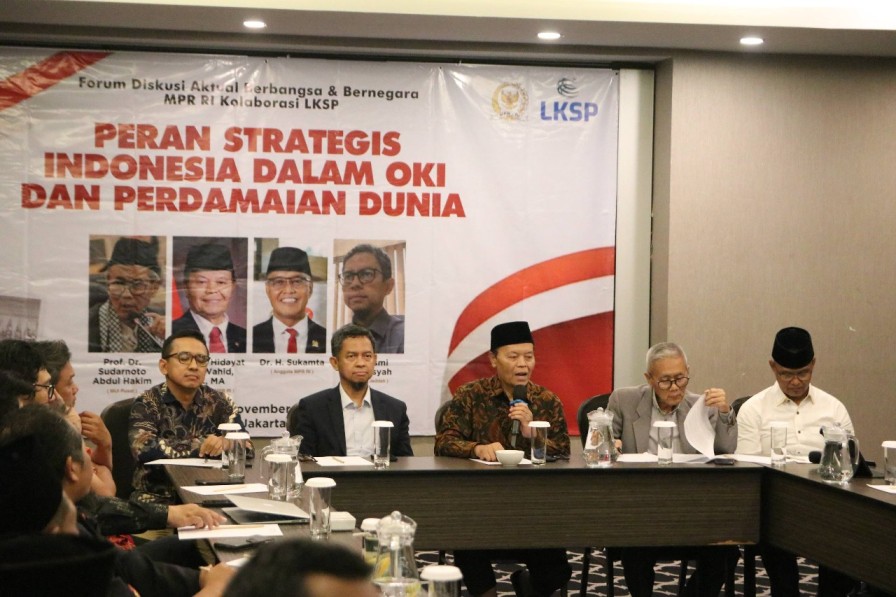
The idea came up at the 'Current National and State Discussion Forum', under the theme ‘Indonesia's Strategic Role in the OIC and World Peace’ on Wednesday (19/11) in Indonesia’s capital Jakarta.
The event featuring speakers, consisting of Deputy Speaker of the Indonesian People's Consultative Assembly (locally known as its abbreviation MPR RI)
Prof. Dr. H.M. Hidayat Nurwahid, Prof. Dr. Sudarnoto Abdul Hakim from the Indonesian Ulema Council (MUI) Central Board, Dr. Sukamta, Deputy Chairman of Commission I of the Indonesian House of Representatives (known as DPR RI), Dr. Yasmi Adriansyah, OIC staff in Jeddah, and Agung Nurwijoyo MA, a lecturer at the University of Indonesia, shared similar views regarding Indonesia’s strategic role and contribution in the OIC.
On the occasion, the speakers expressed the views that Indonesia's role and contribution in the organization should still be enhanced.
Organization of Islamic Cooperation being the second largest organization in the world, with 57 member states spread across Asia, the Middle East, Africa, and America, plays a vital role in realizing Muslim solidarity and advocating for strategic issues, such as those on Palestine, the Rohingya, Islamophobia, and Muslim minorities.
They stated that many people in various regions hope that it is time for Indonesia to demonstrate leadership because the country's role in the OIC has consistently been at the forefront.
"The OIC has become an integral part of Indonesia’s free and active foreign policy. As a founder and early member of the OIC since 1969, Indonesia bears a great responsibility in advocating for strategic issues in the Muslim world in accordance with the Preamble of the 1945 Constitution," Prof. Hidayat Nurwahid said.
According to him,
Indonesia’s foreign policy and the OIC’s objectives run parallel and share common interests. For example, the issue of Palestine—which concerns the independence and rights of the Palestinian people—has been a central element in Indonesia’s foreign policy.
The main reason for the establishment of the OIC was the 1969 burning of the Al-Aqsa Mosque in Al Quds (Jerusalem).
Meanwhile, Dr. Sukamta said that Indonesia has shown leadership for a long time and acted as a ‘striker’ in diplomacy, just as history records Indonesia's ability to host the Asian-African Conference.
"Indonesia's DNA is active and involved in championing strategic issues in the Muslim world," he said.
However, some circles still view Indonesia as seemingly less proactive in promoting new initiatives and demonstrating strong leadership within Organization of Islamic Cooperation to overcome various major emerging challenges, such as the political crises occurring in several member states of Organization of Islamic Cooperation.
Other circles believe that Indonesia holds significant potential to occupy this position as a natural leader.
The speakers said that with the world's largest Muslim population, Indonesia possesses inherent Islamic characteristics and values, such as peace and tolerance.
Despite the similar policy line on Palestine, Indonesia's participation in the OIC is often considered less active compared to its potential.
The transformation of Organization of Islamic Cooperation is expected if the organization is under Indonesia's leadership. This way, Indonesia can also leverage its strategic role to advance national interests.
Since its establishment in Rabat, Morocco, on September 25, 1969, Indonesia has been involved in the formation of Organization of Islamic Cooperation (formerly Organization of the Islamic Conference.
When Organization of Islamic Cooperation first agreed upon the organization's founding charter in 1972, Indonesia initially refused to ratify the OIC Charter on the grounds that Indonesia is not an Islamic state and felt that Arab countries dominated the organization.
Consequently, Indonesia increasingly distanced itself from issues in the Islamic world due to the existing domestic political situation. However, the country later ratified the OIC Charter through Presidential Regulation Number 39 of 2024.
He stated that many circles desire Indonesia to play a major role in the OIC, and so far, the country’s actions have attracted global attention.
Prof. Sudarnoto Abdul Hakim assessed that the veto power held by the five major countries in the UN causes global injustice and needs to be reviewed.
"Based on the mandate of the Preamble of the 1945 Constitution, the principle of washathiyyatul Islam (moderation in Islam), and the mission of Rahmatan lil Alamin (the bounty to the whole universe), the government is encouraged, among other things, to reaffirm Indonesia's free and active political stance and to act as a peacemaker, especially in resolving or seeking solutions to conflicts, such as the Israel-Palestine issue," he said.
As the final speaker, Agung Nurwijoyo presented the political, economic, social, and cultural developments in the regions where OIC members are located.
"The personal closeness of national leaders is expected to enhance relations and cooperation, just as (Indonesia’s first) President Sukarno demonstrated his leadership by hosting the Asian-African Conference," he remarked.
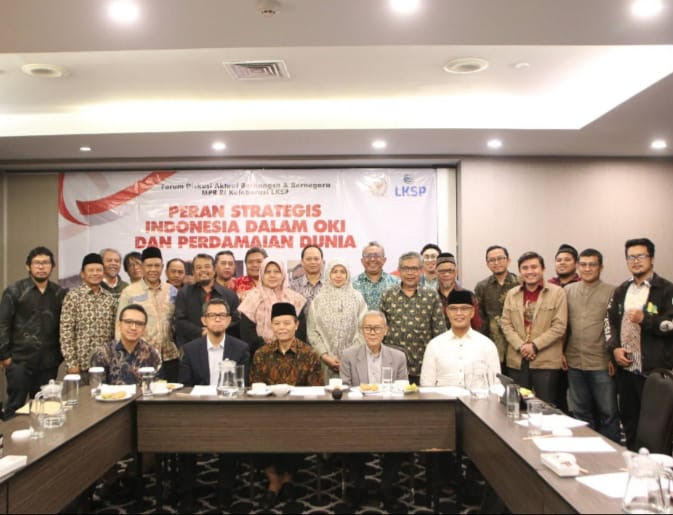
A Current National and State Discussion Forum under the theme ‘Indonesia's Strategic Role in the OIC and World Peace’ on Wednesday (19/11) in Indonesia’s capital Jakarta, featuring a number of speakers including Deputy Speaker of the Indonesian People's Consultative As gbsembly (MPR RI) Prof. Dr. H.M. Hidayat Nurwahid (center). (Photo: Special)
Indonesia's Foreign Policy Contribution to the OICBased on various records and resources of Indonesia's foreign policy activities in the early 1990s, Indonesia began to renew its participation in the OIC.
In 1991, (second) President Suharto first attended the OIC Summit held in Dakar, Senegal. President Suharto delivered a 38-page speech that reviewed major global changes post-Cold War and the resurgence of multilateralism and its impact on countries in the Asia-Africa region and the Islamic world, including the abolition of apartheid in South Africa, the end of the Gulf War, and the reunification of Yemen.
During the administration of President Joko Widodo, Islam has become an important element in Indonesia's foreign policy, not merely a complementary factor for political legitimacy.
The factor of Islamic identity is reflected in the orientation of Indonesia's foreign policy, such as its concern for the Saudi Arabia-Iran conflict, the Rohingya conflict, and peace in Afghanistan, as well as consistent support for Palestine.
Indonesia's confidence in providing input for organizational improvements within the OIC shows that it, as the country with the largest Muslim population in the world, holds a significant role in the Islamic world.
Regardless of its limited role during the New Order era, Indonesia is still regarded as a natural leader among OIC member states.
This is evident from Indonesia's confidence in advocating for important issues related to Muslims worldwide. Indonesia has also been able to secure support from OIC member states in various fields, such as those on politics, economy, and culture.
Indonesia's involvement in the OIC increased in 1996 when the country with more than 280 million peple hosted the 24th OIC Council of Foreign Ministers (CFM) in Jakarta, became part of the Executive Committee, and led OIC sessions.
During the Reforms Era, Indonesia's role in the OIC declined due to the country experiencing serious political, economic, and social crises.
However, after successfully overcoming these crises and enhancing its credibility in the eyes of OIC countries, Indonesia continued to boost its role in the OIC.
President Abdurrahman Wahid, or popularly known as Gus Dur, when attending the 9th OIC Summit in Doha, Qatar, in 2000, emphasized the importance of strengthening economic cooperation among the OIC member states.
Gus Dur also encouraged the OIC to participate in advocating for peace in the Middle East.
During the administration of President Megawati Soekarnoputri (2001-2004), Indonesia was also active in OIC activities. At the 10th OIC Summit in Malaysia in 2003, Megawati delivered a speech emphasizing the importance of cooperation among OIC member states in order to enhance the prosperity and well-being of the people.
During the administration of President Susilo Bambang Yudhoyono (2004-2014), the head of state, popularly known as the abbreviation SBY introduced the concept of Indonesia's international identity: a country where Islam, democracy, and modernity coexist.
Indonesia's uniqueness as the world's largest Muslim-majority country and the world's third-largest democracy has particular relevance in the post-9/11 international atmosphere, in which the perception of Islam is generally negative.
Amid rising religious extremism and terrorism, the global community, especially Western countries, has looked to Indonesia to provide an alternative face for Islam.
Under President SBY's leadership, Indonesia strengthened ties with the OIC and increased its role within it. SBY is noted as the Indonesian President who most regularly attended OIC Summits.
At the 11th Summit in Dakar (2008), for the first time, Indonesia offered to host the OIC Summit, but this did not happen during SBY's administration. SBY also placed global and regional issues as key agendas in Indonesia's relationship with the OIC.
At that time, Indonesia faced challenges related to terrorism, democratic development, human rights, and peace in the Muslim world.
Indonesia also promoted inter-religious dialogue and economic cooperation among OIC countries. In 2011, Indonesia was actively involved in the democratically held election of the OIC Secretary-General, which resulted in the selection of Ekmeleddin İhsanoğlu from Turkey.
In this regard, Indonesia also demonstrated its commitment to strengthening its OIC membership and playing an active role in efforts to maintain peace and stability in the Muslim world.
This is also in line with Indonesia's efforts to enhance preventive diplomacy, which is an effort to prevent conflict before it occurs.
Under the leadership of President Joko Widodo (popularly known as Jokowi) Indonesia continues to play an active role in the OIC.
One of Indonesia's main focuses in the OIC is helping to resolve the Palestinian conflict. In 2018, Indonesia was one of the countries supporting the UN General Assembly Resolution rejecting the United States' recognition of Jerusalem as the capital of Israel.
This action demonstrated Indonesia's strong support for the Palestinian right to the holy city and affirmed that the conflict resolution must be based on applicable international law.
Furthermore, Indonesia also opened an Honorary Consulate in Ramallah, West Bank, in 2019 to strengthen political and economic support for the Palestinian people.
Indonesia is active in various OIC activities, especially on issues related to human rights, Palestine, and Israel. In 2018, Indonesia brought the Rohingya issue to the 45th CFM, which was held in Dhaka, Bangladesh, resulting in Resolution Number 59/45-POL regarding the Establishment of the OIC Ad Hoc Ministerial Committee for Accountability for Human Rights Violations Against the Rohingya.
Through this resolution, all the OIC member states are expected to work together to gather evidence of human rights violations against the Rohingya ethnic minority group in Myanmar.
In addition, Jokowi also visited the Rohingya refugee camp in Cox's Bazar, Bangladesh, in 2018 to provide humanitarian aid. Jokowi referred to the Rohingya refugees as ‘Muslim brothers’ and Indonesia pledged to assist them.
Previously in 2015, Jokowi successfully mobilized $50 million in financial aid from OIC member states for the Rohingya. Then in 2017, Indonesia invited OIC member states to pay special attention to the Rohingya crisis and supported Indonesia's proposal for constructive engagement.
The peak of Indonesia's involvement in the OIC occurred during the Jokowi administration, which was the first time Indonesia hosted the 5th Extraordinary OIC Summit in Jakarta on March 6-7, 2016.
In that meeting, Indonesia, along with OIC member states, launched the ‘Jakarta Declaration’ which contained recommendations for a solution for Palestine and al-Quds al-Sharif.
Jokowi emphasized the importance of solidarity and unity among OIC member states to support the Palestinian struggle.
President Jokowi also attended the 6th Extraordinary OIC Summit in December 2017 to respond to the relocation of the US Embassy to Jerusalem.
Indonesia also actively participated in UN forums related to the Palestinian issue, including as a non-permanent member of the UN Security Council in June 2018.
Indonesia was responsible for creating documents related to Islamic world issues such as Palestine and Afghanistan. As Chair of the UN Security Council in May 2019, Indonesia demonstrated its high commitment to international leadership for world peace through the theme ‘Investing in Peace.’
In the third year of his leadership, Jokowi also appointed Maha Abou Susheh as Indonesia's Honorary Consul in Ramallah to strengthen Indonesia's presence in Palestine.
The increase in Indonesia's activity in the OIC during the Jokowi era was also marked by the appointment of Dr. Alwi Shihab (Indonesian Minister of Foreign Affairs, 1999–2001) as the President's Special Envoy for the Middle East and the OIC.
Furthermore, officially, Indonesia also had its first Permanent Representative to the OIC, concurrently held by the Indonesian Ambassador to the Kingdom of Saudi Arabia, Agus Maftuh Abegebriel, who submitted his Letter of Introduction to the OIC Secretary-General in April 2016.
Another breakthrough during the Jokowi administration was the initiation of the formation of the OIC Contact Group on Peace and Dialogue (OIC CGPD) at the 13th Islamic Summit in Istanbul in April 2016.
Initially, the CGPD was formed to build a strategy for solving problems faced by countries in the Islamic world.
However, in its development, the CGPD was mandated to strengthen efforts to prevent religious discrimination, Islamophobia, intolerance, and hatred towards Muslims when a terrorist attack occurred on a Mosque in Christchurch, New Zealand, in 2019.
Through the CGPD, Indonesia encouraged the OIC to cooperate with the UN and the European Union in monitoring and implementing constructive dialogue on the issue of Islamophobia.
The CGPD serves as a forum for OIC members to discuss non-traditional issues that are difficult to accommodate within the formal OIC structure and acts as a meeting forum for OIC member states to find common ground on sensitive issues without political barriers.
In July 2019, Indonesia hosted the inaugural meeting of the CGPD in Jakarta. At this meeting, Indonesia successfully incorporated the principle of moderate Islam through the CGPD output document called the Plan of Action on Islamophobia, Religious Discrimination, Intolerance, and Hatred Towards Muslims 2020-2023, which became a global benchmark.
On March 15, 2022, the UN General Assembly adopted a resolution sponsored by the group of OIC member states at the UN, which established March 15 as the International Day to Combat Islamophobia.
This date was chosen to commemorate the tragedy of the terrorist attack in the form of a mass shooting at two mosques in Christchurch, New Zealand.
The Plan of Action document emphasizes that terrorism and violent extremism cannot and should not be linked to any religion, nationality, civilization, or ethnic group.
The resolution calls for a global dialogue on promoting a culture of tolerance and peace, based on respect for human rights and religious and belief diversity.
Thus, the International Day to Combat Islamophobia is proof that the OIC group at the UN is the largest and most influential and effective group at the UN in promoting an issue of common interest.
Furthermore, this breakthrough also shows that Indonesia, as an OIC member, has an important role on the international stage.
Reporting by Indonesia Window


.jpg)